
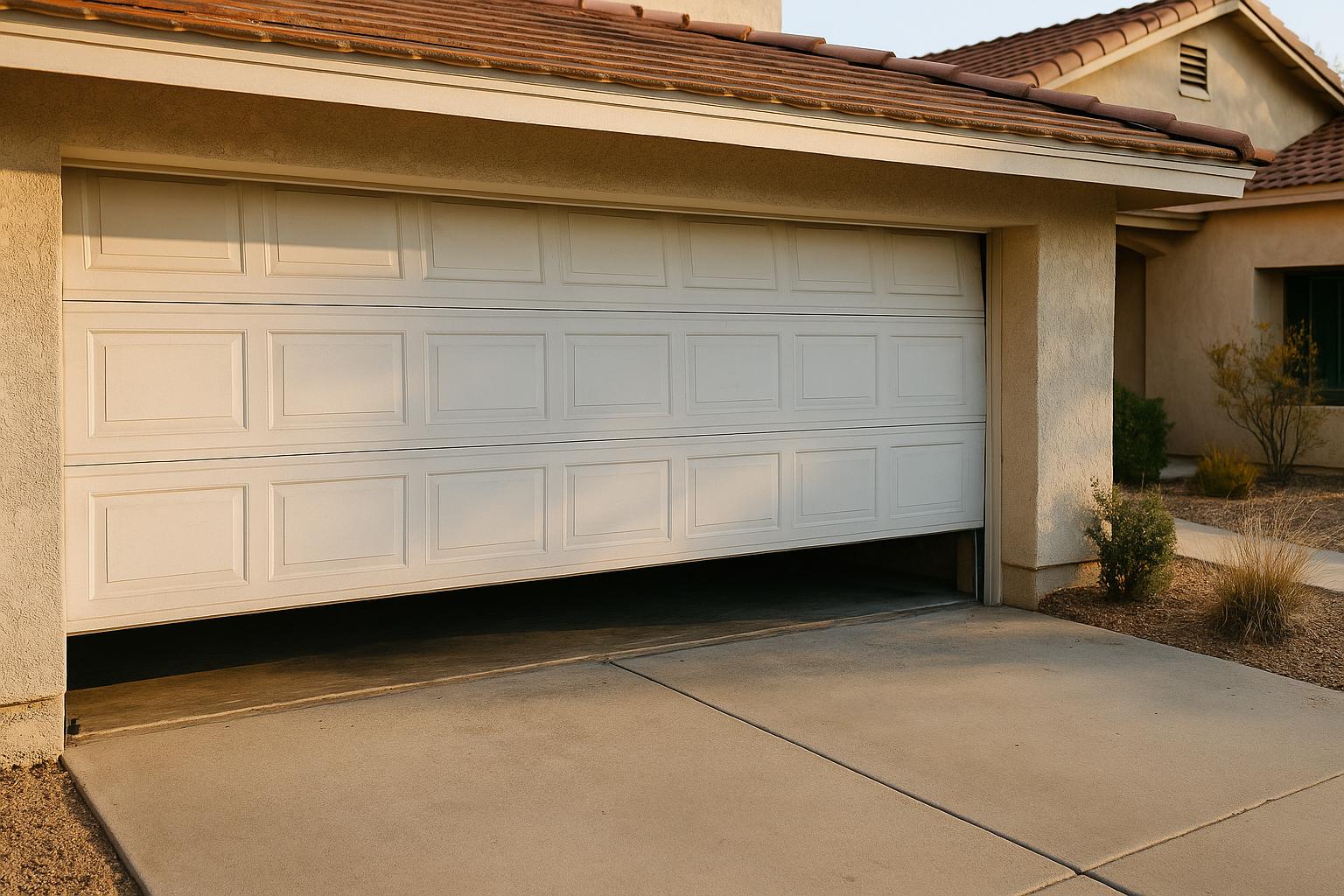
That Frustrating Reverse: What's Going On?
You press the button on your garage door remote, the door starts its descent, and then — just before it reaches the floor — it stops and reverses back up. You try again. Same thing. Maybe you try holding the wall button. Still reverses. It's one of the most common and frustrating garage door problems homeowners in Thousand Oaks deal with, and it can happen seemingly out of nowhere.
The good news is that this behavior is actually a safety feature working as designed. The bad news is that something is triggering it incorrectly. Let's walk through the most common causes and what you can do about each one.
1. Misaligned Safety Sensors
This is the number one reason garage doors reverse before closing completely. Since 1993, all garage door openers sold in the United States have been required to include photoelectric safety sensors — those small devices mounted near the bottom of your garage door tracks on either side.
These sensors send an invisible beam across the doorway. If anything breaks that beam while the door is closing, the opener reverses the door to prevent crushing a child, pet, or object. It's an essential safety feature, but the sensors can become misaligned from something as simple as a bump from a bicycle tire or a kid's basketball.
How to Check
- Look at the LED lights on both sensors. Typically, one sensor has a green light (sending unit) and the other has an amber or red light (receiving unit).
- If either light is off or flickering, the sensors are misaligned or obstructed.
- Clear any cobwebs, dirt, or debris from the sensor lenses — this is surprisingly common in our area, especially during Santa Ana wind season when dust gets everywhere.
- Gently adjust the sensor that's flickering until the light becomes steady.
If you've cleaned and adjusted the sensors and the problem persists, the wiring between the sensors and the opener may be damaged, or the sensors themselves may need replacement.
2. Something Is Blocking the Door's Path
Before diving into mechanical troubleshooting, do a simple visual check. Is there anything on the garage floor near the door's path? A small rock, a piece of wood, a garden hose, or even a raised section of the garage floor seal can trigger the safety reverse. Remove any obstructions and test the door again.
3. The Close-Force Setting Needs Adjustment
Your garage door opener has a force setting that determines how much resistance the door should encounter before the opener assumes something is in the way and reverses. If this setting is too low, the door may reverse when it meets the normal resistance of contacting the ground.
On most openers, you'll find the force adjustment dials or screws on the back or side of the motor unit. There's usually one for the open force and one for the close force. Try increasing the close-force setting by a small increment — typically a quarter turn — and test the door.
A word of caution: Don't crank this setting up excessively. The force limit exists to protect people and property. If you need to set it very high for the door to close, there's likely an underlying mechanical issue that needs professional attention.
4. Worn or Damaged Tracks
Over time, garage door tracks can develop bends, dents, or buildup of hardened grease and debris. When the rollers hit these problem spots, the added friction can trigger the opener's force limit, causing a reversal.
Inspect the tracks on both sides of the door from top to bottom. Look for:
- Visible bends or dents in the metal
- Gaps between the track and the wall mounting brackets
- Buildup of grime or hardened lubricant
- Rollers that appear worn, cracked, or wobbly
You can clean the tracks with a rag and a mild household cleaner. However, if the tracks are bent or the rollers are worn, it's best to call a professional. Attempting to bend tracks back into shape without proper tools can make the problem worse or create a safety hazard.
5. Broken or Worn Springs
Your garage door springs do the heavy lifting — literally. They counterbalance the weight of the door so the opener only needs to provide a small amount of force to move it. When springs weaken with age or partially break, the door becomes much heavier for the opener to manage.
If the springs are failing, you might notice that the door feels unusually heavy when you try to lift it manually, or that the opener strains and reverses during closing. Springs under tension are extremely dangerous to work with. This is one repair we strongly recommend leaving to trained technicians. A spring replacement done incorrectly can result in serious injury.
6. The Travel Limit Is Set Incorrectly
The travel limit tells your opener exactly how far the door should move in both the open and close directions. If the close travel limit is set too short, the opener thinks the door has traveled farther than it actually has and reverses before the door reaches the ground.
Adjusting the travel limit is usually done with a dial or screw on the opener unit. Increase the down-travel setting in small increments and test after each adjustment. The door should touch the floor gently and the opener should stop without the door pushing hard against the ground.
7. Worn Gear or Drive Assembly
If you hear grinding noises when the door operates, the internal gears in the opener may be stripped or worn. This is common in older chain-drive and screw-drive openers that have been in service for 15 or more years. Many homes in established Thousand Oaks neighborhoods like Dos Vientos, Wildwood, and Lang Ranch have openers that are approaching or past this age.
A worn gear assembly usually requires professional repair or, depending on the age of the opener, may justify a full opener replacement with a newer, quieter model.
When to Call a Professional
Some of these fixes — cleaning sensors, removing obstructions, making small adjustments — are reasonable for a handy homeowner to tackle. But if you've gone through the basics and your door still reverses, or if the issue involves springs, tracks, or internal opener components, it's time to bring in help.
At Thousand Oaks Garage Door Works, we diagnose reversing issues quickly because we see them every week. We serve homeowners throughout the Conejo Valley, including Newbury Park, Westlake Village, Agoura Hills, and Oak Park, with same-day service available for most calls.
A reversing garage door isn't just an inconvenience — it's a security issue. Every night your door won't stay closed is a night your garage and everything in it is exposed. If you're dealing with this problem and the DIY fixes aren't solving it, give us a call and we'll get your door closing properly again.